
A simple guide to Electronic Data Interchange
Businesses exchange thousands of documents every day, from purchase orders and invoices to delivery notes and payment information. Processing these documents manually takes time, creates opportunities for errors and can slow down operations.
Electronic Data Interchange (EDI) makes this process faster and more reliable by allowing businesses to exchange information automatically.
But what exactly is EDI, how does it work, and why do businesses use it?
What is EDI?
Electronic Data Interchange (EDI) is the automated exchange of business documents between companies in a standard electronic format.
Instead of sending purchase orders, invoices or delivery information by email or post, EDI allows this information to move directly between business systems.
For example, when a retailer places an order with a supplier, EDI can automatically transfer that order from the retailer’s system into the supplier’s system, without anyone having to manually enter the details.
This reduces administrative work, improves accuracy and helps businesses process transactions more efficiently.
How does EDI work?
Although the technology behind EDI can be complex, the basic process is straightforward.
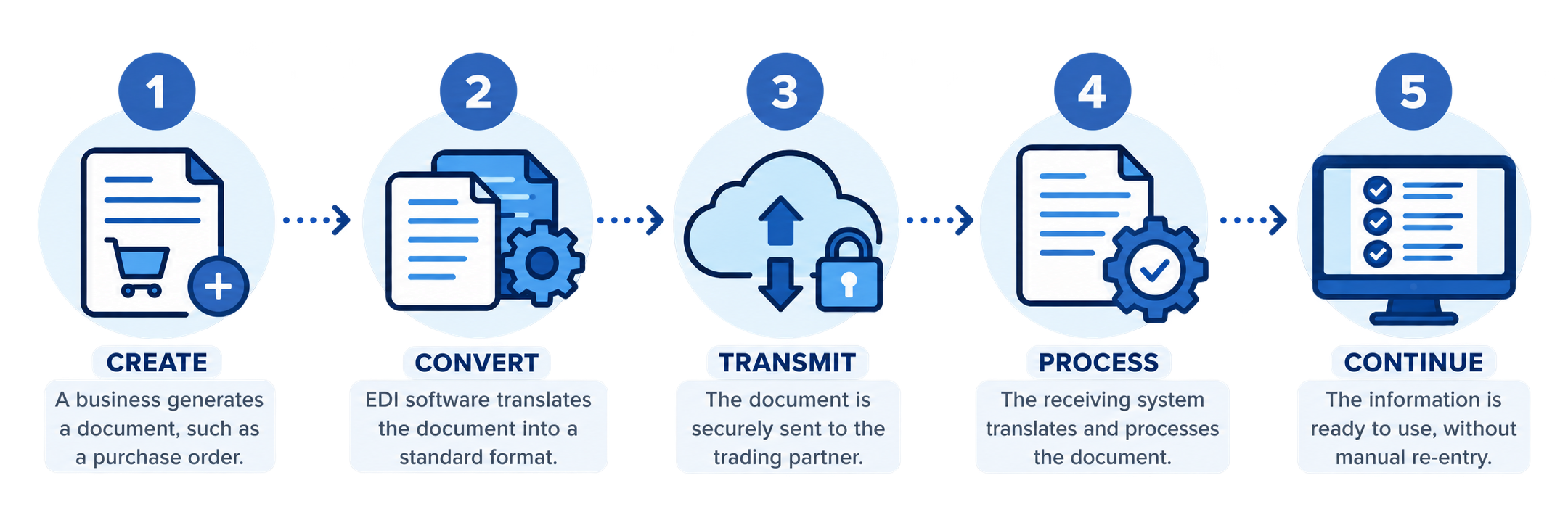
1. A Document is Created:
A business generated a purchase order, invoice or another document in its existing system.
2. The Information Is Converted:
EDI software translates the document into a standard format that the receiving business can understand.
3. The Document Is Sent:
The information is securely transmitted to the trading partner.
4. The Receiving System Processes It:
The document is translated into the format required by the recipient’s system.
5. The Transaction Continues:
The receiving business can process the information without manually re-entering it.
This process can happen in seconds, even when the two businesses use completely different software.
What documents can be exchanged using EDI?
EDI supports a wide range of business documents, including:
- Purchase orders: Requests to buy goods or services.
- Order confirmations: Acknowledgements that an order has been received or accepted.
- Invoices: Requests for payment following a sale.
- Despatch advice: Information about goods being shipped.
- Inventory reports: Updates on stock availability.
- Credit notes: Documents recording adjustments to amounts owed.
- Remittance advice: Information about payments made.
By automating the exchange of these documents, businesses can reduce repetitive tasks and keep information moving through their supply chains.
What are the business benefits of EDI?
EDI helps businesses work more efficiently by automating document exchange, reducing errors and improving communication with trading partners.
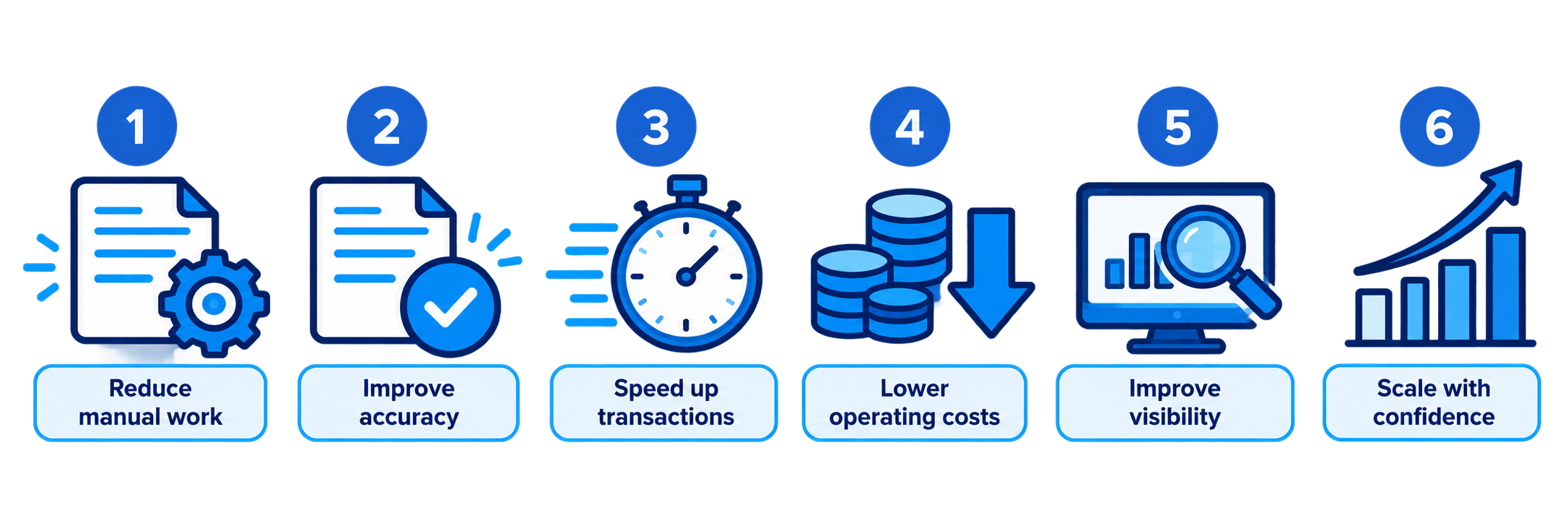
1. Reduce manual work
Eliminate repetitive data entry and free up employees to focus on more valuable tasks.
2. Improve accuracy
Reduce human error by transferring information directly between business systems.
3. Speed up transactions
Exchange orders, invoices and other documents in seconds, rather than relying on manual processing.
4. Lower operating costs
Cut administrative costs by reducing paperwork, manual intervention and time spent resolving errors.
5. Improve visibility and collaboration
Track transactions more easily and keep customers and suppliers informed with accurate, timely information.
6. Scale with confidence
Handle increasing transaction volumes and new trading partners without adding unnecessary complexity.
What are EDI standards?
For EDI to work, businesses need an agreed way of structuring the information they exchange.
These agreed formats are known as EDI standards. They ensure that information can be understood and processed correctly, even when trading partners use different business systems.
Some common standards include:
- EDIFACT: Widely used internationally, particularly in retail and supply chains.
- Tradacoms: A long-established standard still used by some UK retailers.
- ANSI X12: Commonly used in North America.
- VDA: Used primarily in the automotive industry.
- Peppol BIS: Used for structured electronic business documents, particularly in procurement and e-invoicing.
Businesses don’t necessarily need to use the same internal software. An EDI solution can translate information between different formats and systems.
What's the difference between EDI and an API?
EDI and Application Programming Interfaces (APIs) both allow systems to exchange information, but they often serve different purposes.
EDI is designed for exchanging structured business documents using agreed standards. It’s particularly useful for established trading relationships involving orders, invoices and delivery information.
APIs allow applications to communicate and request information, often in real time. They can support activities such as checking stock availability or retrieving order updates.
The two technologies can work together. A business might use EDI to exchange purchase orders with a retailer while using APIs to access live inventory information.
Modern integration platforms can support both approaches, helping businesses connect systems and trading partners without creating unnecessary complexity.
Which businesses use EDI?
EDI is used across many industries, particularly where businesses exchange large volumes of documents.
Retailers use it to manage orders and supplier relationships. Manufacturers rely on it to coordinate purchasing and production. Logistics providers use it to exchange shipping and delivery information, while healthcare organisations and public sector bodies use structured electronic documents to support procurement and financial processes.
EDI can benefit businesses of different sizes, especially those managing growing transaction volumes or working with trading partners that require electronic document exchange.
Getting started with EDI
Introducing EDI doesn’t have to mean replacing your existing systems or completely changing how your business operates.
The right solution can connect to your current ERP, accounting or business applications, allowing information to flow automatically between your organisation and its trading partners.
Before choosing an EDI solution, it’s worth considering the documents you exchange, the systems you use, your trading partners’ requirements and how much manual processing you’d like to eliminate.
A flexible, scalable approach will also help you accommodate new customers, suppliers and business requirements as your organisation grows.
Make business transactions easier with Netix
Netix helps businesses connect their systems, customers and suppliers through automated document exchange and integration.
By supporting EDI alongside modern integration and workflow capabilities, Netix helps reduce manual processing, improve transaction accuracy and simplify the management of business information.
Want to know more?
Enter your details below or call us on +44 (0) 1772 977781