Why Organisations Use Added Value Modules
Replace Manual Workarounds
Replace spreadsheets, emails and repetitive manual tasks with consistent, automated processes.
Respond Faster to Customer Requirements
Apply customer-specific rules, validations and processes without repeatedly changing your core systems.
Reduce Errors and Avoidable Costs
Validate information before it becomes an operational problem — helping prevent rejected transactions, incorrect charges and avoidable customer penalties.
Add What You Need as Your Business Changes
Introduce new customers, warehouses, 3PL providers, tax rules and operating models without redesigning your entire integration environment.
Add The Capabilities Your Business Needs
Practical modules for real operational requirements.
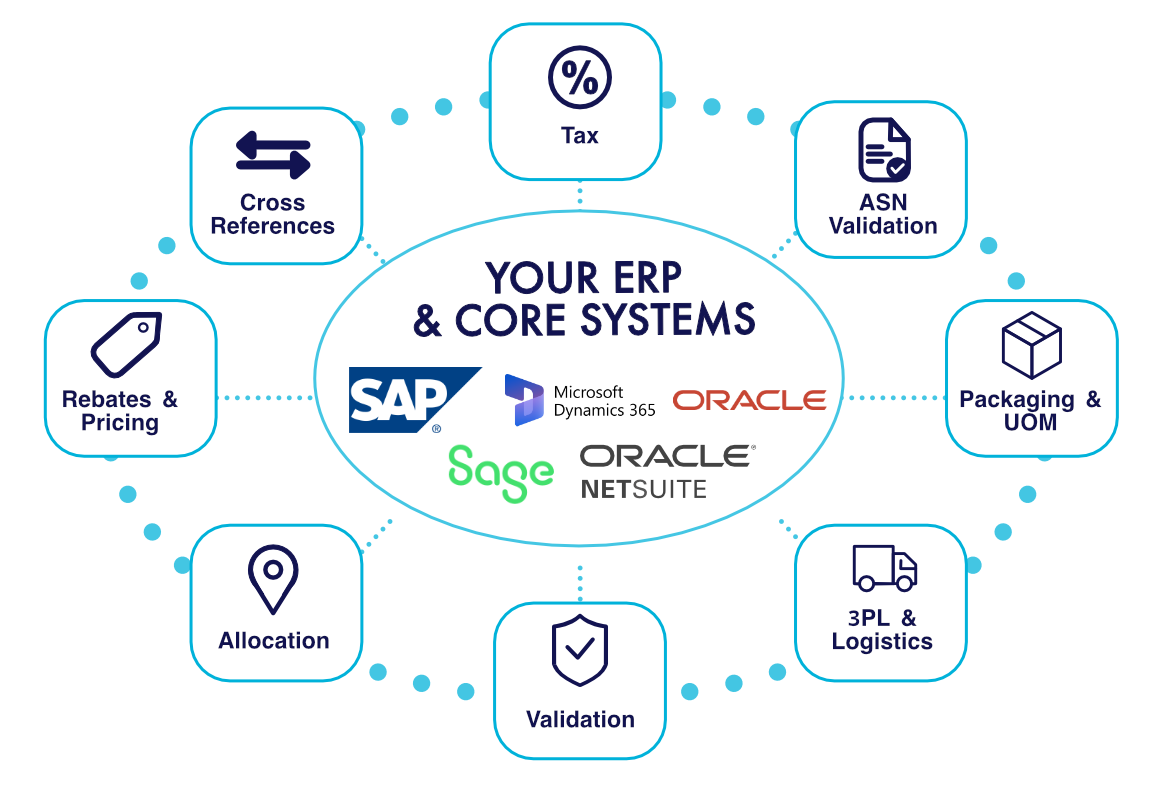
Product Cross-References
Automatically translate internal product codes into the references required by individual customers, suppliers or trading partners.
ASN Validation
Validate shipment information against customer requirements before transmission, reducing rejected ASNs and potential compliance charges.
Tax Validation
Apply country, customer, product or transaction-specific tax rules consistently across business processes.
Packaging & UOM Rules
Manage customer-specific packaging, pack sizes, units of measure and conversion requirements.
Rebates & Pricing
Apply and validate agreed pricing, discounts, rebates and commercial rules.
Location Allocation
Automatically route transactions according to stores, warehouses, distribution centres or other business locations.
3PL & Warehouse Allocation
Apply flexible rules to determine which warehouse or logistics provider fulfils an order.
Business Rules & Validation
Create additional validations, enrichment and decision logic around orders, invoices and other business transactions.
Built Around Your Existing Systems
Netix Added Value Modules work alongside your existing systems.
Whether you use SAP, Microsoft Dynamics, Oracle, NetSuite, Sage, or other business applications, you can add modules wherever extra automation or business rules are needed. That means you can address a specific operational requirement without turning it into a major transformation programme.
Part Of The Netix Platform


What Could You Automate?
Sometimes the biggest opportunities are hiding in everyday processes. If your teams are maintaining spreadsheets, manually checking transactions, applying customer-specific rules or repeatedly working around the same operational requirement, there may be a simpler way. Let us identify where targeted automation could reduce manual work, prevent errors and make processes easier to manage as your business grows.